Technology
Power you can point at.
Each tree is a closed loop of generation, storage and measurement, and every claim on this page is a number an operator can audit.
The system
A grove that behaves like a power station and looks like a park.
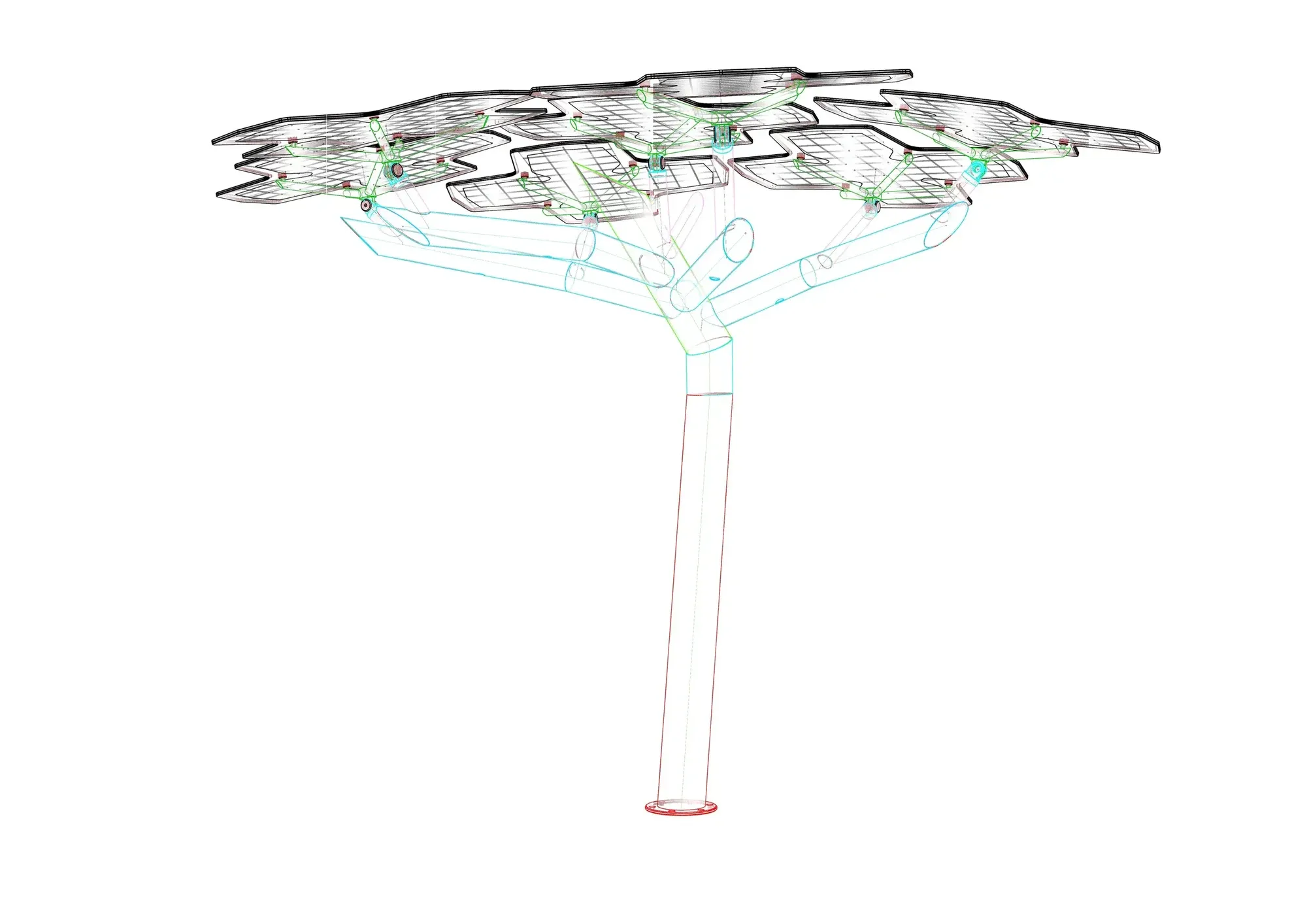
Sunlight is converted at the canopy, buffered in storage inside the trunk, and released into whatever the marina needs: berth supply, lighting, charging points, service hubs. The elevated canopy shades seating, boardwalks and waiting areas below, which are themselves running on the tree above them.
Compared with a solar field or an offshore array, the intervention is small. Installation requires minimal excavation and no marine works, which keeps both the coastal ecosystem and the permitting timeline intact.
Performance · United Arab Emirates
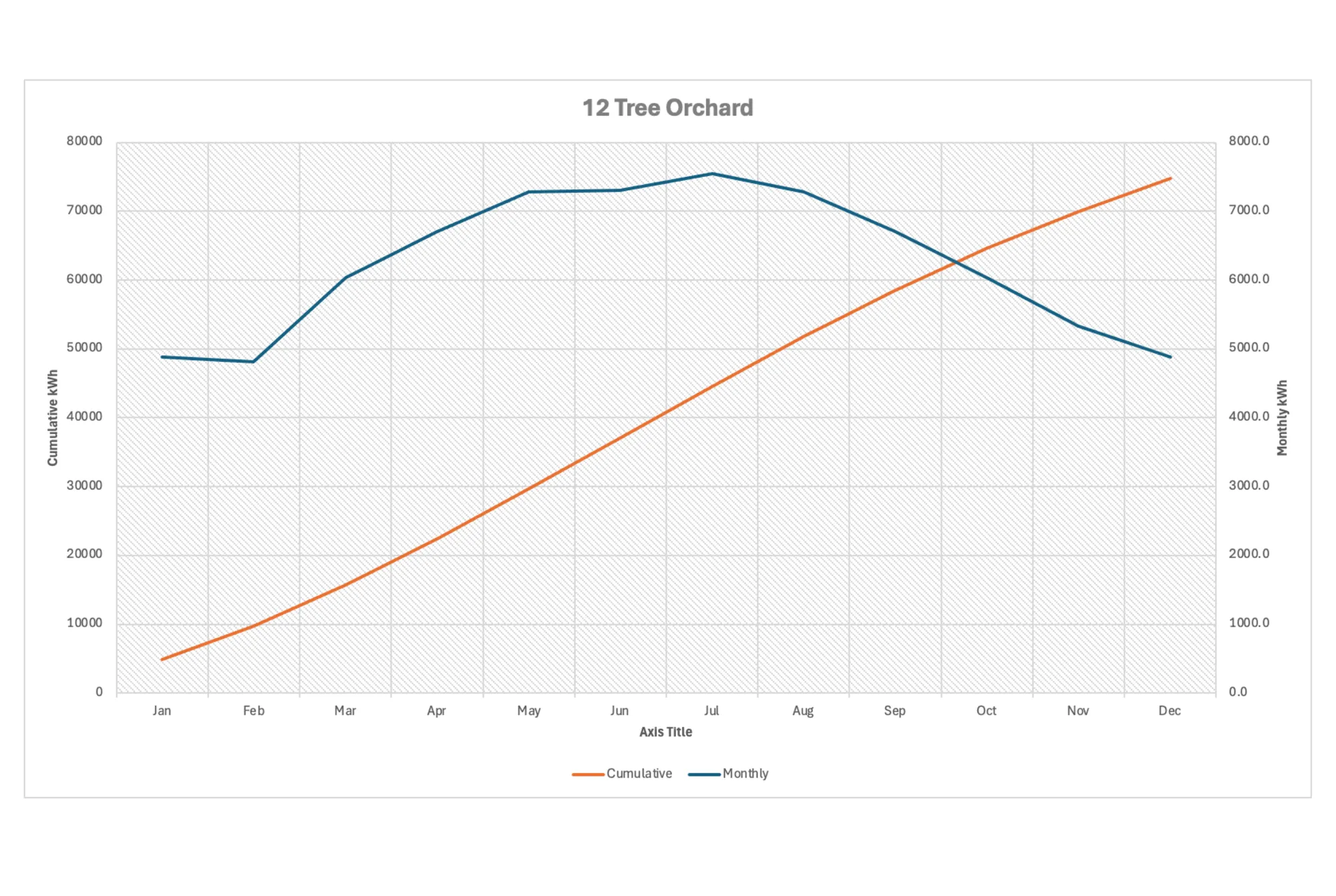
Twelve trees, one harbour, measured.
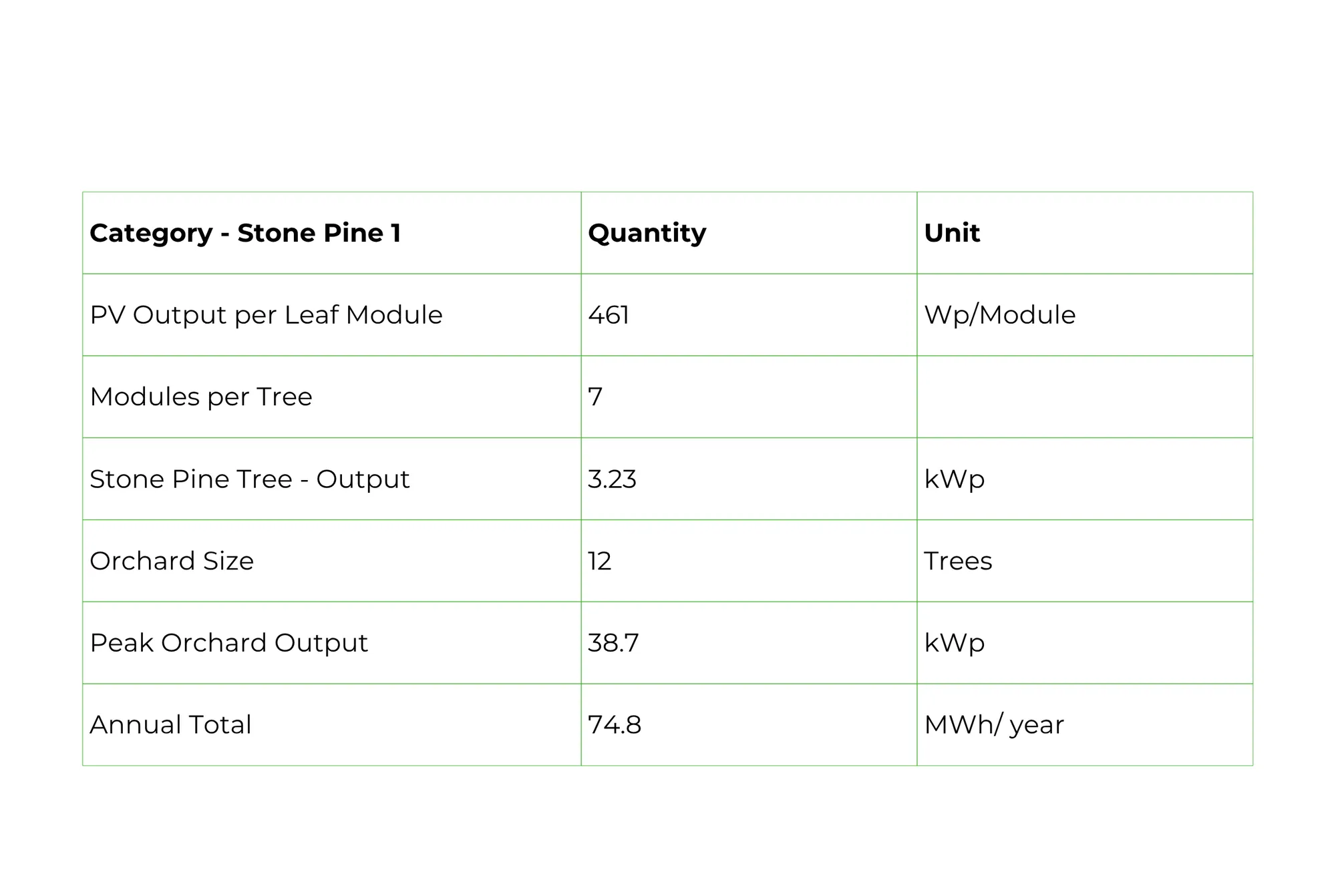
- 3.2kW
- Peak output, single tree
- 38.7kWp
- Orchard of twelve trees
- 74.8MWh
- Generated per year
- 15yrs
- Modelled subsidy horizon
- 01Charges three electric marina RIBs or buggies (46 kWh each) 936 times a year, a combined 131,040 nautical miles.
- 02Runs 154 LED promenade lights at 40 W for twelve hours, every night.
- 03Supports twelve multi-purpose hubs combining Wi-Fi, information screen, first aid point and charging.
- 04Models to roughly AED 337,500 in energy subsidy value across fifteen years.
Figures modelled on United Arab Emirates weather averages for an orchard of twelve trees. Output at other latitudes varies with local irradiance; site-specific modelling is part of every proposal.
What is inside the trunk
Photovoltaic canopy
Type-approved triple-laminate glass panels, shaped to the canopy geometry and capable of carrying integrated lighting within the same surface.
Integrated storage
Batteries housed within the structure, sized to carry night-time loads such as lighting, security and service points.
Sensors and telemetry
Continuous monitoring of production, consumption and state of charge, exposed as live data rather than an annual report.
Smart-marina integration
Designed to speak to existing harbour management platforms, so the orchard appears alongside the systems an operator already runs.
Marine-grade envelope
Stainless steel and marine aluminium throughout, specified against salt, humidity and sustained heat rather than inland conditions.
Illuminated canopy
The lit canopy can carry imagery or colour, turning a piece of energy plant into a night-time feature for the waterfront.
Technology
Marine Solar Tree specifications, in plain terms
- What is the output of one Marine Solar Tree?
3.2 kW at peak. Twelve trees together reach 38.7 kWp and generate 74.8 MWh in a year under United Arab Emirates irradiance, a figure modelled on measured data rather than a best case.
- What is inside the trunk?
Storage sized for night-time loads, the inverter and switchgear, and the sensors that report generation, consumption and state of charge. The trunk is the plant room, so nothing has to be housed elsewhere on the quay.
- What can 74.8 MWh actually run?
In a year, it charges three electric marina RIBs or buggies of 46 kWh each 936 times, a combined 131,040 nautical miles. Or it runs 154 LED promenade lights at 40 W for twelve hours every night. Or it supports twelve multi-purpose hubs combining Wi-Fi, an information screen, a first aid point and charging.
- Can the trees talk to a smart-marina system?
Yes. Telemetry is built in, so generation and consumption can be read out per tree and fed into whatever platform the marina already runs.
- What materials are used?
Type-approved triple-laminate glass in the canopy, stainless steel and marine aluminium in the structure. The panels are shaped to the canopy geometry and can carry lighting within the same surface.
- Is the lighting separate from the solar?
No, it is the same surface. The lit canopy can carry colour or imagery, which turns a piece of energy plant into a night-time feature for the waterfront.
Send us your site and we will model the yield.
Request a study